Stryker Corporation (SYK): Engineering the Future of Healthcare

1. The Premise: A MedTech Compounder with Two Compounding Engines
The medtech industry is undergoing a structural transformation unlike any in its history. Three forces are converging simultaneously: the most powerful demographic tailwind in recorded medicine — an ageing global population whose joint, cardiovascular, and neurological needs are growing faster than healthcare systems can absorb them; the accelerating integration of artificial intelligence and robotics into surgical and clinical workflows; and the digitisation of the hospital itself, where siloed, analogue environments are being rewired into connected, data-generating ecosystems. At the intersection of all three, Stryker Corporation (NYSE: SYK) occupies a position that is rare in large-cap investing: a company of significant scale that retains genuine, defensible optionality.
The central investment thesis is built on two distinct compounding engines, operating in parallel. The first is the Mako robotic platform — an AI-native system that has accumulated more than 2 million orthopaedic procedures across 46 countries, is installed in over 3,000 hospitals globally, and is generating a proprietary dataset of surgical outcomes that grows more valuable with every operation performed. No competitor can acquire this dataset. It cannot be bought. It can only be built, procedure by procedure, over years of patient care. The second engine is the SmartHospital Platform — a newly launched enterprise operating system for hospitals that integrates Stryker's physical devices, AI-powered ambient intelligence, and clinical communication tools into a unified digital layer that transforms the company's relationship with its hospital customers from transactional supplier to indispensable infrastructure partner.
Underpinning both engines is a demographic certainty that should give long-term investors considerable comfort: the world is ageing, and ageing bodies need more of what Stryker makes. Japan, the world's most advanced case study in demographic transition, where 30% of the population is already over 65 — provides a clear forward preview of what is coming globally. Its medtech market has consistently outperformed its pharmaceutical counterpart in revenue growth, driven by the structural inelasticity of demand for orthopaedic, neurovascular, and patient-handling solutions. That same dynamic is now beginning to play out across Europe, the United States, and increasingly in Asia-Pacific markets beyond Japan.
2. History: The Surgeon Who Couldn't Stop Innovating
2.1. From the Operating Table to the Patent Office
The genesis of Stryker Corporation is the purest origin story in MedTech. Dr Homer H. Stryker was a practising orthopaedic surgeon in Kalamazoo, Michigan, whose proximity to his patients gave him an unfiltered view of where medicine was failing them. Unlike the founders of most medical device companies, who typically came from engineering or business backgrounds, Dr Stryker's innovations were born directly from clinical frustration.
His first and perhaps most consequential invention was the Stryker Frame, developed in the early 1940s to solve a specific and immediate problem: how to safely reposition patients with serious spinal injuries without compromising vertebral immobilisation. Nursing staff needed to turn bedridden patients to prevent pressure sores, but the standard techniques of the era risked further injury to an already compromised spine. The oscillating frame he designed allowed a patient to be rotated from prone to supine (front to back) whilst keeping the spinal column rigidly supported between two opposing frames. It was a characteristically simple, elegant, and immediately clinically useful solution, and it would define the company's DNA for the next eight decades.
By the time Dr Stryker retired from active medical practice in 1964, he had brought approximately four to five products to market, each one a direct response to a problem he had personally encountered in the operating theatre or at the patient's bedside. The company was incorporated as Orthopaedic Frame Company in 1946 before being renamed Stryker Corporation, and it completed its initial public offering in 1980. The IPO marked the beginning of a more formalised growth strategy, though the company retained its characteristic focus on surgical instruments and orthopaedic devices throughout the 1980s and into the 2000s.
The pace of strategic evolution accelerated meaningfully under the leadership of John Brown and later Stephen MacMillan, as Stryker began deploying a more systematic approach to tuck-in acquisitions across endoscopy, instruments, and patient-handling equipment. By the mid-2000s, the company had established itself firmly as one of the three largest orthopaedic device manufacturers in the world.
2.2. The Lobo Era: Platform Thinking at Scale
The arrival of Kevin Lobo as CEO in 2012 ushered in the most consequential strategic period in the company's post-founder history. Lobo, who joined from Siemens Healthineers, brought with him a conviction that Stryker's future lay not just in implants and instruments but in technology-enabled, data-driven healthcare delivery. His tenure has been defined by a handful of transformational acquisitions, each one a deliberate addition to an increasingly coherent platform and by a financial discipline that has delivered consistent double-digit earnings per share growth over twelve years of leadership. More about this later.
3. How does Stryker make money?
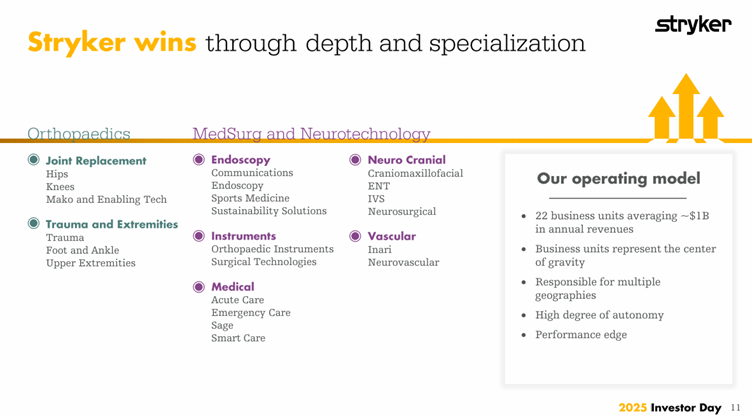
Stryker organises its operations into two reportable segments: MedSurg and Neurotechnology, and Orthopaedics. Whilst these labels suggest a clean division, the practical reality is that the two segments are progressively functioning as complementary components of a unified platform strategy, with robotics, AI, and data flowing across both.
3.1. MedSurg and Neurotechnology
At $15.7 billion in fiscal 2025 revenue, approximately 62% of the total group — MedSurg and Neurotechnology is both the larger and the faster-growing of the two segments, expanding by approximately 16% year-over-year. It encompasses five distinct product divisions.
Instruments ($2.8 billion) encompasses orthopaedic instruments and surgical technologies. These include the System 8 and System 9 platforms which comprise of the sagittal saw, reciprocating saw, rotary drill, sternum saw and other power tools and other surgical tools such as filtrations devices, suction devices, oxygen mask and others.
Endoscopy ($3.4 billion) covers advanced visualisation systems for minimally invasive surgery alongside fluid management and operating room communication tools.
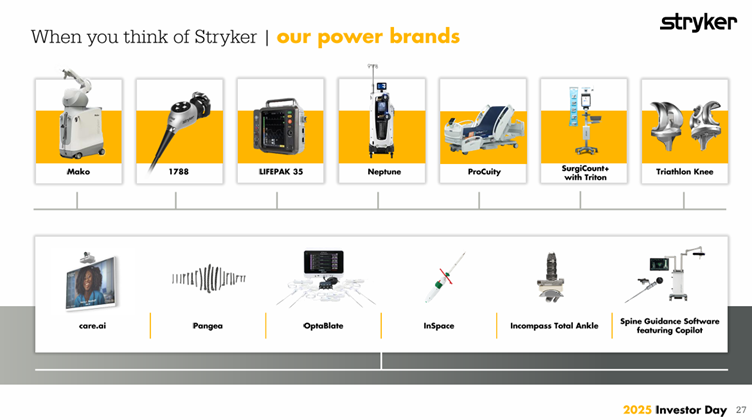
Medical ($3.9 billion) — the segment's largest division — encompasses patient-handling equipment (notably the ProCuity smart hospital bed), emergency medical solutions (including the LIFEPAK franchise, with the next-generation LIFEPAK 35 experiencing robust demand and a strong order book), intensive care disposables, and clinical communication and an AI-assisted virtual care platform technology. This last category is the organisational home of the SmartHospital buildout.
Neurovascular ($1.3 billion) covers devices for the treatment of stroke and cerebral aneurysms. Stryker is a globally recognised leader here, with the 2025 commercial launch of the next-generation Surpass Elite Flow Diverter representing a meaningful product cycle catalyst. In a separately announced collaboration, Stryker and Siemens Healthineers are jointly developing a robotic system for neurovascular procedures that integrates robotics, imaging, access devices, and implants — targeting improved outcomes in stroke and aneurysm treatment.
Neuro Cranial ($2.1 billion) includes neurosurgical products for craniomaxillofacial reconstruction and interventional spine.
3.2. Orthopaedics
Orthopaedics generated $9.1 billion in 2024 and $9.5 billion in 2025, representing approximately 38% of total revenue. It is the segment most investors immediately associate with Stryker.
Knees is anchored by the Triathlon Total Knee System, engineered for optimal performance in Mako-guided procedures. Cementless knee replacement, where Stryker holds the market leadership position continues gaining procedural share. Recent publications highlight over 99% ten-year survivorship for Stryker's cementless offerings, a clinical data asset that competitors have not matched.
Hips includes the Accolade and Insignia total hip systems. The 2025 unveiling of Mako Total Hip with Advanced Primary and Revision — the first robotic hip revision capability on the market — is a meaningful clinical differentiator with no direct equivalent in the competitive landscape.
Trauma and Extremities, substantially enlarged by the 2020 Wright Medical acquisition, covers fracture management, foot and ankle, shoulder, and hand and wrist procedures. Stryker now holds over 30% market share in upper extremities — structural dominance in one of orthopaedics' highest-growth subcategories. This segment is expected to see further growth with Mako Shoulder being released which will enable robotic surgeries for shoulder replacements.
Spinal Implants rounds out the segment, providing surgical solutions for fusion and stabilisation. This segment has been divested and will soon be gone from their financial statements.
4. Acquisitions: A Decade of Deliberate Platform Assembly
Stryker has made 54 acquisitions in its history, with the pace accelerating markedly in the Lobo era. The company's approach combines large, thesis-defining transactions with a steady cadence of smaller tuck-in deals that fill specific product gaps. Following the Wright Medical integration, Lobo signalled a return to a more active pipeline in 2024, and the company delivered: SERF SAS (France, hip implant IP), Artelon (soft tissue fixation for sports medicine and foot and ankle), care.ai (ambient AI), and then the $4.9 billion Inari Medical transaction announced in January 2025.
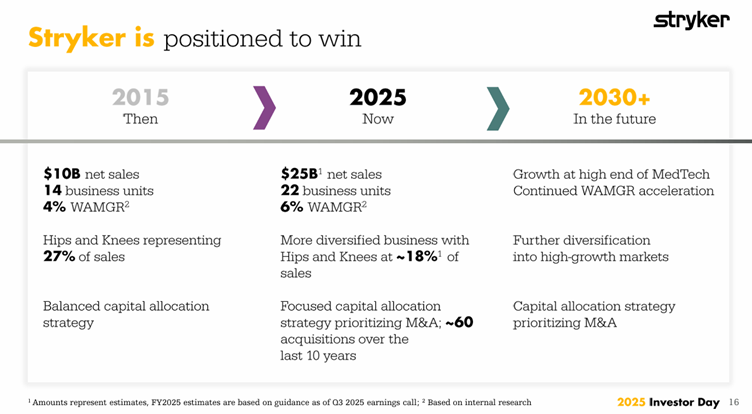
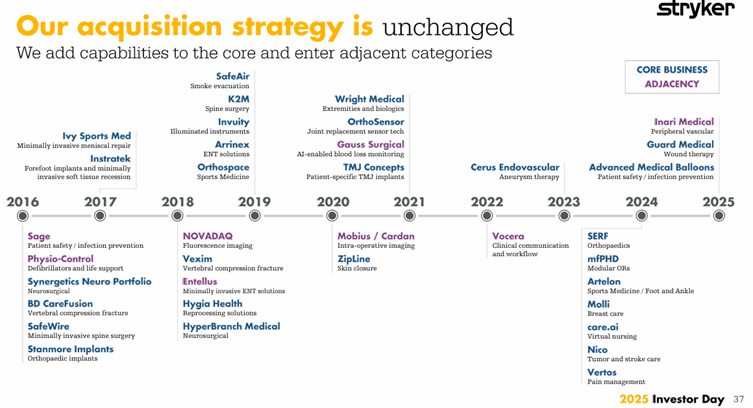
Stryker's acquisition history is architectural. Each major transaction over the past decade can be mapped directly to a specific gap in the platform the company was building. The M&A discipline under Kevin Lobo has been notable: large deals have been followed by periods of deliberate deleveraging before the next significant transaction, allowing the balance sheet to recover and integration to be managed without financial duress.
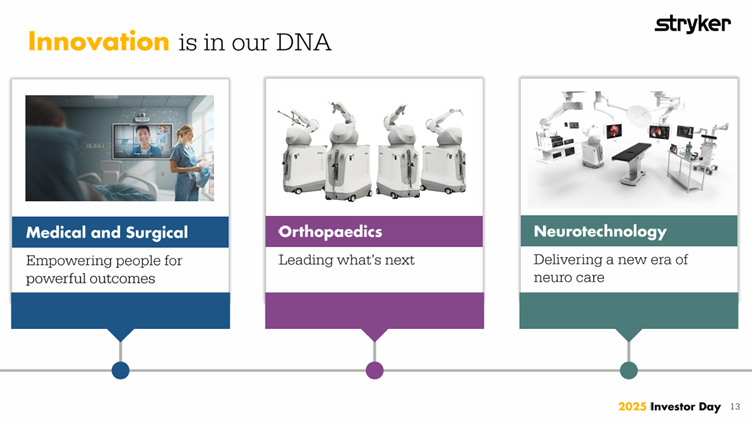
Neurotechnology is of particular focus now, on this front Styker acquired Inari and recently acquired Amplitude. Management hasn’t indicated other areas of focus current so it is probably focused on building this segment out first.
4.1. The Foundational Transactions (Pre-2020)
The 2013 acquisition of Mako Surgical for approximately $1.7 billion is the pivotal transaction in Stryker's modern history. At the time, Mako was a relatively small Florida-based company. The strategic logic has since been vindicated beyond all reasonable expectation: Mako has become the most commercially successful robotic orthopaedic platform globally (more about Mako’s install based and how its driving digital surgical planning in later sections).
|
Acquisition |
Year |
Value |
Strategic Rationale |
|
Mako Surgical |
2013 |
~$1.7B |
Robotic-assisted surgery; the
anchor of the entire platform |
|
Small Bone Innovations |
2014 |
Undisclosed |
Hand and wrist implants;
extremities expansion |
|
Physio-Control |
2016 |
$1.3B |
Emergency medical; LIFEPAK
franchise |
|
Novadaq Technologies |
2017 |
$700M |
Fluorescence imaging for surgical
visualisation |
|
K2M |
2018 |
$1.4B |
Complex spine; digital enabling
platform |
|
OrthoSensor |
2018 |
Undisclosed |
Smart sensor technology;
intraoperative data capture for joint replacement |
4.2. The Build-Out Phase (2020–2026)
The six years between 2020 and 2026 represent the most ambitious and diverse M&A programme in the company's history, spanning orthopaedics, digital health, peripheral vascular medicine, and sports surgery.
|
Acquisition |
Year |
Value |
Strategic Rationale |
|
Wright Medical |
2020 |
$4.7B |
Market leadership in upper
extremities |
|
Gauss Surgical |
2021 |
Undisclosed |
AI-powered blood loss monitoring;
real-time OR analytics |
|
Vocera Communications |
2022 |
$3.1B |
Hospital communication &
workflow; Smart Hospital foundation |
|
Cerus Endovascular |
2023 |
Undisclosed |
Neurovascular flow disruption
devices |
|
SERF SAS |
2024 |
Undisclosed |
Dual Mobility Cup innovation; hip
implant IP; European presence |
|
Artelon |
2024 |
Undisclosed |
Synthetic soft tissue fixation for
foot, ankle, and sports medicine |
|
care.ai |
2024 |
Undisclosed |
Ambient AI, virtual care, smart
room technology |
|
Inari Medical |
2025 |
$4.9B |
Peripheral vascular; venous
thromboembolism (VTE) market entry |
|
Amplitude Vascular Systems |
2026 |
Undisclosed |
Next-generation intravascular
lithotripsy (IVL) platform |
Several of these deserve particular attention. The 2022 Vocera acquisition for $3.1 billion was initially viewed sceptically by some analysts as a departure from Stryker's core hardware business. It is not clear that this acquisition is the essential communication layer of the SmartHospital Platform — the "nervous system" without which the ambient intelligence and virtual care capabilities of care.ai would have no mechanism for delivery into clinical workflows.
The 2025 acquisition of Inari Medical for $4.9 billion represents the most significant strategic expansion beyond orthopaedics and neurotechnology in Stryker's history. Inari brings a leading position in the venous thromboembolism (VTE) segment, a fast-growing peripheral vascular market characterised by high unmet clinical need and limited competition. Its product portfolio, built around nitinol-enabled thrombectomy systems for pulmonary embolism and deep vein thrombosis, is highly complementary to Stryker's existing Neurovascular division and creates a materially larger cardiovascular franchise.
As a follow on to the Inari Medical acquisition, Styker announced in April 2026 that it is acquiring Amplitude Vascular Systems which is developing a next-generation intravascular lithotripsy (IVL) platform designed to treat calcified peripheral arterial disease. This would be a strong complement to Stryker’s PV portfolio. This potentially indicates that the PV market is current a focus areas for Stryker as it looks to plug this gap in its portfolio of offerings.