
Edwards Lifesciences (EW) — From Valve Pioneer to Structural Heart Powerhouse

1. The Premise
Today we are going to be looking at a company whose entire existence is concentrated on solving one disease, in one organ, for one population of patients — and which has spent six decades doing so with such singular intensity that it has become genuinely irreplaceable. Edwards Lifesciences (NYSE: EW) is that company.
Every revenue dollar Edwards generates comes from the structural heart. Every research programme is aimed at a valve. Every clinical trial, every physician relationship, every acquired patent and manufacturing process is organised around a single biological problem: the progressive failure of the four valves that regulate blood flow through the human heart. This is not a description of a company with a niche. It is a description of a company that has, over time, redefined what structural heart medicine is and what it can become.
The investment thesis rests on three interlocking realities that do not require heroic assumptions to accept. First, heart valve disease is a disease of ageing, and the world is ageing faster and more extensively than at any prior point in human history. Second, the treatment gap remains extraordinarily wide, even after two decades of rapid TAVR adoption. Third, Edwards holds a combination of intellectual property, clinical evidence, physician relationships, and manufacturing expertise that no competitor has yet replicated and that took 65 years to accumulate.
What makes this moment particularly interesting is the transition Edwards is navigating. TAVR, the technology that defined the company's last fifteen years, is maturing, while still growing, still dominant, but no longer comes with the hypergrowth driver it once was. In its place, Transcatheter Mitral and Tricuspid Therapies (TMTT) is becoming the company's next multi-billion dollar franchise, at exactly the moment when the underlying patient populations are receiving their first meaningful treatment options. Lets dig in deeper below.
2. History: From a Surgeon's Workshop to the TAVR Era
2.1. The Founding Partnership (1958)
The story of Edwards Lifesciences begins not in a boardroom but in an operating theatre, with a conversation between a retired aeronautical engineer and a cardiac surgeon that would eventually reshape the treatment of heart disease. Dr Miles Edwards approached Dr Albert Starr at the University of Oregon Medical School in 1958 with a deceptively simple proposal: build an artificial heart valve. The audacity of the suggestion was considerable — the heart was not yet a routine surgical target, and the idea of replacing one of its components with a mechanical device built in a workshop was, to most of the medical establishment, preposterous.
They proceeded anyway. The Starr-Edwards caged-ball valve — a silicone rubber ball trapped inside a metal cage, positioned at the aortic or mitral annulus to prevent backflow was implanted in its first human patient in 1960. The patient survived. The device worked. And a company that would become Edwards Lifesciences had found its reason for existing.
What is worth appreciating about the origin is not just its scientific achievement but its cultural implication. Edwards was founded by people who were clinically frustrated, those who saw patients die from conditions that engineering, applied with sufficient ingenuity, might address. That patient-first orientation has persisted through every subsequent generation of management and every product generation that followed. It explains why Edwards consistently runs the landmark randomised controlled trials in its fields rather than relying on registry data. It explains why its physician relationships are qualitatively different from those of its competitors. And it explains why, when the company faced a choice between retaining a profitable monitoring business and betting everything on valve innovation, it chose the valve.
2.2. The Baxter Years and the Independence Decision (1985–1999)
Edwards Laboratories was acquired by American Hospital Supply in the early 1960s and subsequently passed to Baxter International when Baxter acquired that business in 1985. The Baxter decades were productive for the heart valve division — successive tissue valve generations were developed, manufacturing was scaled, and a global commercial infrastructure was built. But by the late 1990s, it had become clear to Baxter's management that the heart valve business occupied an awkward position within a conglomerate whose strategic ambitions were focused on intravenous therapies and hospital supply logistics. The heart valve division was profitable, but it was not strategically central.
In 1999, Baxter spun out the division as an independent publicly traded company: Edwards Lifesciences Corporation, listed on the New York Stock Exchange under the ticker EW. The new company launched with approximately $600 million in revenue, a strong position in surgical tissue valves, a respected brand among cardiac surgeons, and a mandate to innovate in ways that a division of a diversified conglomerate never quite could. Michael Mussallem, who would go on to serve as CEO for the entire 24-year independent existence of the company until his transition to Chairman in 2023, was there from the beginning.
2.3. The Acquisition That Changed Everything: PVT (2004)
If there is a single transaction that defines the arc of Edwards Lifesciences as an investment, it is the 2004 acquisition of Percutaneous Valve Technologies, a small Israeli startup founded by cardiac surgeon Dr Alain Cribier and engineer Stanton Rowe, for approximately $125 million.
PVT held the foundational patents on transcatheter aortic valve replacement, the concept of delivering a replacement aortic valve via catheter through the femoral artery, bypassing open-heart surgery entirely. Dr Cribier had performed the world's first human TAVR implantation in Rouen, France in 2002. The device worked but was primitive. Edwards acquired the IP, the team, and the scientific vision, and spent the next seven years turning the concept into a commercial product.
The strategic parallel that Mussallem himself drew, when asked by Goldman Sachs analysts why Edwards acquired CardiAQ a decade later even while running its own TMVR programme, was instructive. He invoked PVT: a second, complementary approach that gives you another option during the long regulatory process, whose valve data is often relevant regardless of delivery approach. The PVT acquisition did not merely give Edwards a product. It gave Edwards the habit of acquiring early-stage structural heart technology before the regulatory and clinical pathway was clear.
2.4. TAVR Comes of Age (2011–2021)
FDA approval for TAVR in inoperable patients arrived in November 2011, the first transcatheter heart valve cleared anywhere in the United States. High-surgical-risk approval followed in 2012. The PARTNER trials that underpinned these approvals represented some of the most rigorous randomised data in the history of cardiovascular medicine and established an evidentiary standard that competitors have had to match ever since. More on this below.
3. The Disease: Biology, Demographics & the Ageing Imperative
Before examining what Edwards has built, it is worth understanding precisely what it is treating because the biology of valve disease is inseparable from the commercial opportunity, and the demographics of the patients who suffer from it are the most powerful long-term demand driver in this investment thesis.
3.1. The Architecture of the Heart — Four Valves, Four Markets
The human heart is a dual pump, operating two parallel circulatory systems simultaneously. The right side receives deoxygenated blood from the body via the venae cavae and pumps it to the lungs, where it picks up oxygen. The left side receives that oxygenated blood from the pulmonary veins and pumps it at high pressure into the aorta and thence to the rest of the body.
Each side of the heart contains two chambers, an atrium, which receives blood, and a ventricle, which pumps it, separated by a valve that functions as a one-way door. A healthy valve opens fully when the upstream chamber contracts and closes tightly when it relaxes, ensuring that blood moves only in one direction with each heartbeat. Over a human lifetime, the average heart beats approximately 2.5 billion times. Each valve opens and closes with every one of those beats. The mechanical stress this implies particularly on the aortic valve, which operates at the highest pressures in the cardiovascular system is extraordinary, and it explains why valve disease is fundamentally a disease of accumulated wear.
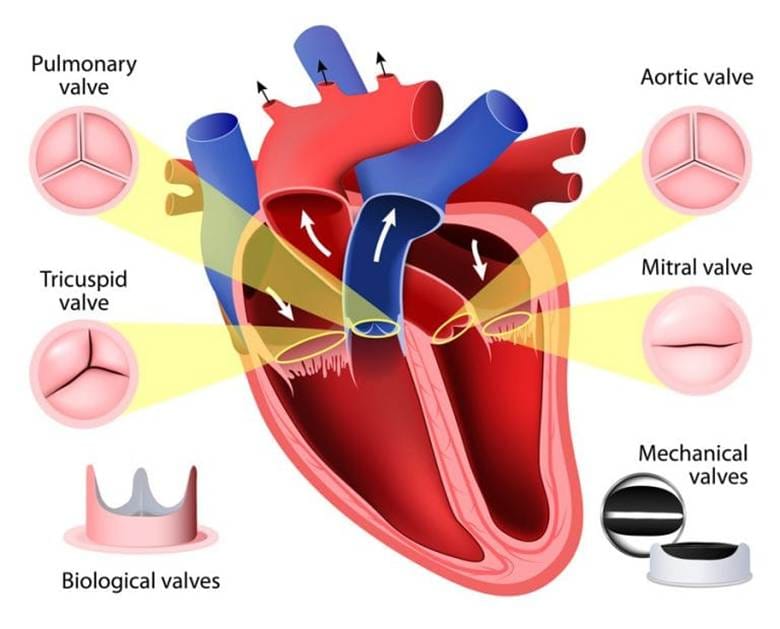
The four valves Edwards addresses are:
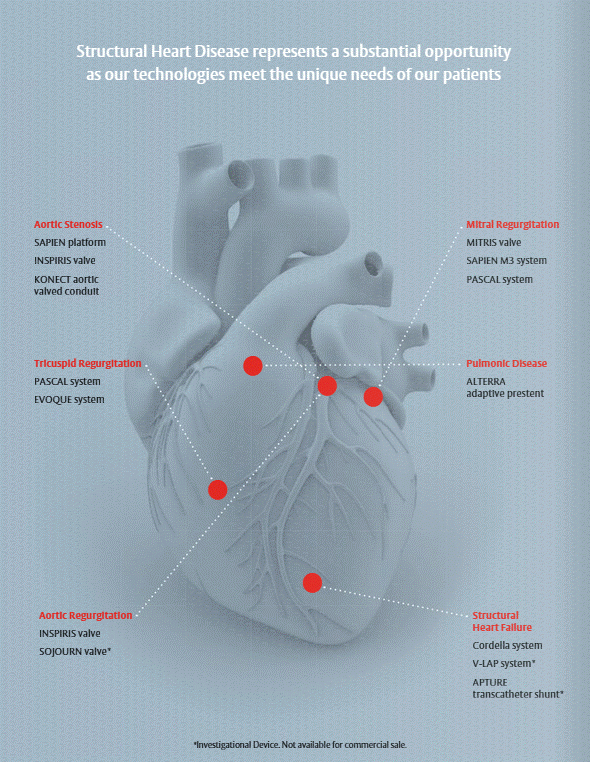
- The aortic valve sits between the left ventricle and the aorta. It has three crescent-shaped leaflets that open during ventricular systole to allow blood into the aorta and snap shut during diastole to prevent backflow. This is the site of aortic stenosis, Edwards' core market, and the valve addressed by the entire SAPIEN TAVR platform.
- The mitral valve separates the left atrium from the left ventricle. Unlike the aortic valve, it has only two leaflets, an anterior and a posterior and is held in place by a complex apparatus of fibrous chords (chordae tendineae) anchored to the ventricular wall by papillary muscles. This complexity makes the mitral valve both the most anatomically variable valve in the body and the most technically challenging to treat transcatheterly. It is the target of the PASCAL Precision system and the SAPIEN M3 transcatheter replacement programme.
- The tricuspid valve governs flow between the right atrium and right ventricle. Its three leaflets are the largest and most variable in size of any cardiac valve. For decades, tricuspid disease was undertreated and often labelled the 'forgotten valve' by interventional cardiologists on the assumption that fixing the left-sided disease driving secondary tricuspid regurgitation would allow the tricuspid to recover. It often does not. Edwards' EVOQUE replacement and PASCAL TR repair systems represent the only commercially available comprehensive toolkit for transcatheter tricuspid intervention.
- The pulmonary valve controls flow between the right ventricle and the pulmonary artery. It is the least frequently diseased valve in adults and is not a primary commercial focus for Edwards, though transcatheter pulmonary valve procedures exist for congenital heart disease.
The four heart valves and their clinical relevance to Edwards' portfolio:
3.2. How Valves Fail — and Why It Matters for Edwards
Valve disease takes two fundamental forms, and they are almost opposites in mechanism:
- stenosis, where the valve becomes rigid and obstructs flow, and
- regurgitation, where it fails to close and allows backflow.
Aortic stenosis is the most prevalent surgically significant valve disease in the developed world. It begins with lipid deposition and inflammatory changes in the valve leaflet, a process that resembles atherosclerosis followed by progressive calcification that stiffens and eventually immobilises the leaflets.
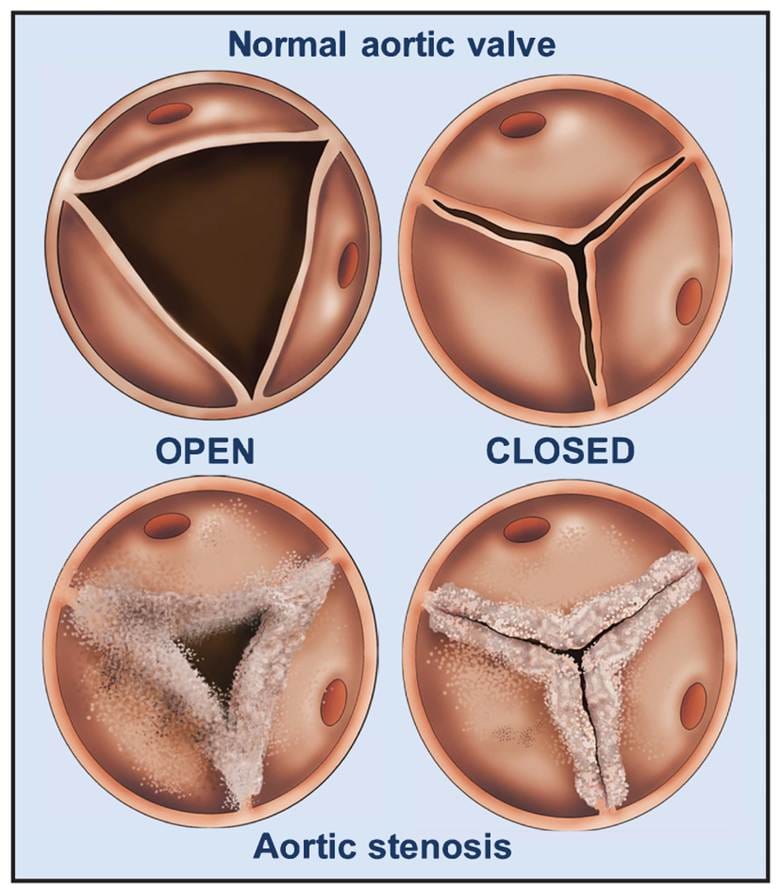
The resulting obstruction forces the left ventricle to work harder with each beat to eject blood through the narrowed opening. Over years, this pressure overload causes the ventricle to hypertrophy (become bigger), its wall thickens, it becomes less compliant, and eventually it dilates and fails. The classic triad of symptoms — chest pain, breathlessness, syncope — marks the transition from compensated to decompensated disease. Once symptoms appear, untreated severe aortic stenosis carries a two-year mortality of approximately 50%, a figure that compares unfavourably with many malignancies.
Mitral regurgitation is the most prevalent valvular heart disease globally, estimated to affect 25 million people with at least moderate severity. It arises either from primary disease of the valve apparatus itself such as degenerative changes causing leaflet prolapse, as in Barlow's disease or fibroelastic deficiency or from secondary (functional) causes where a diseased left ventricle preventing the leaflets from coapting (closing) normally. The haemodynamic consequence is a volume overload on both the left atrium and ventricle as blood regurgitates backwards with each systole. The clinical trajectory is variable but ultimately leads to left heart failure, atrial fibrillation, and death.
Tricuspid regurgitation is the most undertreated of the three major valve diseases. It affects an estimated 10 million people globally with at least moderate severity, but fewer than 3% currently receive any form of intervention. TR is predominantly functional — driven by right heart remodelling secondary to left-sided heart failure, pulmonary hypertension, or atrial fibrillation-induced annular dilatation. Its long-term consequences include right heart failure, hepatic congestion, ascites, and progressive debility. The combination of high prevalence, high clinical impact, and near-zero treatment rate makes tricuspid disease the largest single unmet need in structural cardiology.
3.3. The Age-Disease Relationship — Why Demographics Drive the Thesis
The epidemiology of valve disease has one defining characteristic: prevalence rises steeply with age. Severe aortic stenosis affects approximately 2% of the population over 65 but approaches 10% in octogenarians. The calcification process that drives AS is time-dependent; there is no pharmacological agent that reliably slows it, and there is no cure other than valve replacement. TR prevalence similarly rises with age, driven by the accumulation of left-sided heart disease and atrial fibrillation that come with decades of cardiovascular wear. Mitral regurgitation affects patients across the age spectrum but the secondary (functional) form — the dominant clinical phenotype and the most relevant to TEER therapy — is overwhelmingly concentrated in older patients with heart failure.
The world's population over 80 is projected to triple from 143 million today to 426 million by 2050. Since severe aortic stenosis prevalence exceeds 10% in octogenarians, the demographic shift alone implies a near-tripling of the addressable TAVR patient population over the next 25 years — without any improvement in diagnosis or treatment rates.
This is not the normal demographic tailwind that medtech analysts routinely cite for any company that sells something to older patients. This is a structural, time-locked compounding of the patient pool driven by a biological process — calcification — that no pharmaceutical intervention currently addresses. Edwards does not need to grow its market share to grow its revenue. The market is growing towards it.
3.4. The Treatment Gap — The Overlooked Statistic
In the decade since TAVR became broadly available for high-risk patients, the technology has unambiguously transformed the treatment of severe aortic stenosis. More than 1 million TAVR procedures have been performed globally. Physician training programmes have proliferated. Structural heart centres have been established in hospitals that previously referred all valve cases to tertiary centres.
And yet, studies across multiple healthcare systems consistently find that 30–50% of patients with severe symptomatic aortic stenosis who reach a structural heart programme never receive a valve intervention. This could be due to multiple reasons with a key reason being old age (in some patients who are over 75 the risk of other complications outweighs the benefits of surgery). As such, in 2025 asymptomatic treatment was approved potentially opening up the possibility of getting treated at an earlier age before onset of symptoms such as in their late 60’s. One of the hesitations currently seems to be the lifespan of the TAVR valve which needs last at least 15 years as a repeat surgery would be highly challenging. This is the critical data that is holding back the change in treatment plans todays.
For mitral and tricuspid disease, the treatment gap is not 30–50%. It is 90–97%. An estimated 25 million people have moderate-to-severe mitral regurgitation. Approximately 8–10% receive any intervention. The remainder manage conservatively — with diuretics, beta-blockers, and other heart failure therapies that address symptoms but leave the underlying mechanical cause of their disease untreated. For tricuspid regurgitation, the treatment rate is below 3% of those with at least moderate severity. These are not treatment gaps. They are treatment deserts.
3.5. Why Age Matters for Treatment Choice
There is a reason that TAVR, rather than surgical aortic valve replacement, is the dominant treatment modality for aortic stenosis in anyone over 75. It is not simply that TAVR is less invasive. It is that open-heart surgery in an 80-year-old with multiple comorbidities — diabetes, chronic kidney disease, prior coronary artery disease, reduced lung function — carries a perioperative mortality risk that in many cases exceeds the risk of not operating at all. TAVR does not reduce this risk modestly. It reduces it dramatically. The PARTNER 1 trial showed that in patients deemed inoperable for surgical replacement, TAVR reduced mortality (5 year: 71.8%) versus medical management (5 year: 93.6%) by a factor that has rarely been seen in cardiovascular medicine.
The same logic applies to mitral and tricuspid repair. The median patient requiring TEER — transcatheter edge-to-edge repair — with MitraClip or PASCAL is in their mid-70s, with a left ventricular ejection fraction already reduced by the volume overload of regurgitation, and with additional comorbidities that make general anaesthesia and a sternotomy a genuine clinical risk rather than a manageable inconvenience. The transcatheter approach, which in skilled hands requires a 90-minute procedure under sedation with an overnight hospital stay, changes the risk calculus entirely for this population.
The broader conclusion is one that frames the entire investment thesis: valve disease is a disease of physical calcification and mechanical failure. It is, quite literally, a mechanical problem that requires a mechanical solution. The frailest patients in the world's most rapidly ageing societies need minimally invasive options — and no pharmaceutical pipeline currently in development changes that reality on any investment-relevant time horizon.
Biocompounding's portfolio is now accessbile to all readers:
We are up 14% this year.