
Intuitive Surgical (ISRG): What Three Years and a New Robot Changed
A Note to Readers
When we first wrote about Intuitive Surgical, the company was the unambiguous, effectively unchallenged leader of a market it had created. The investment thesis was compelling but simple: a dominant installed base, an annuity stream of instruments and service revenue, and a regulatory and switching-cost moat that kept competitors at bay while the world's surgical community progressively converted to robotic-assisted approaches.
Three years on, the landscape is considerably more interesting. Intuitive has launched the most significant hardware upgrade in its history. The competitive field has not just expanded, it has globally proliferated, with Chinese manufacturers executing a commercialisation pace that most Western analysts significantly underestimated. The financial profile of the business has accelerated materially. And the question that was speculative in 2023, “what does Intuitive do when it has to compete?” is no longer hypothetical.
This update covers the period from early 2023 to June 2026 and is written as a standalone piece. Familiarity with the original deep dive is useful but not required, but it can be found here (Deep Dive) and here (Crutial Metrics to track).
1. What Has Changed: The Last Three Years
The period from 2023 to mid-2026 has been the most consequential in Intuitive's history since the original FDA clearance of the da Vinci system in 2000. Three developments stand above the rest.
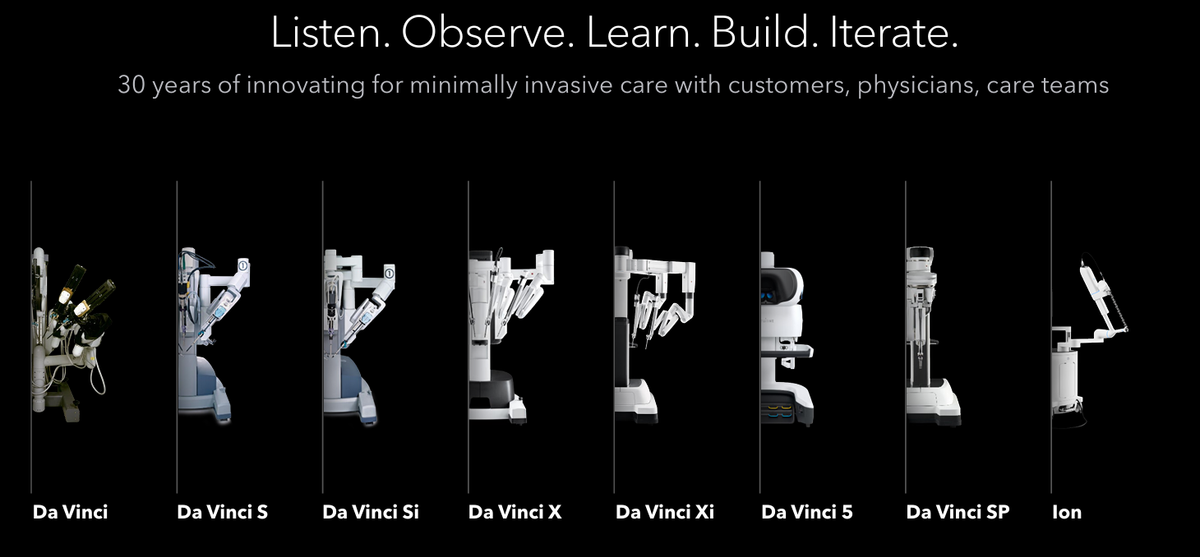
First, da Vinci 5 arrived and exceeded every expectation. FDA clearance came in March 2024. By Q4 2025, Intuitive was placing 303 dV5 systems in a single quarter, with approximate 1,500 dV5’s placed to date. The system's 10,000x computing power advantage over the Xi is not just a marketing figure, it is the architectural precondition for everything that is meaningfully new about the platform, from force feedback to surgical video replay to the AI-assisted future that Intuitive's leadership team has been articulating with increasing specificity.
Second, the competitive field transformed from nuisance to genuine contest. When we last wrote, Medtronic's Hugo was a regulatory aspiration in the United States, J&J's Ottava had been delayed so many times it had become a running joke in the surgical robotics community, and CMR Surgical's Versius was a respected European operator still building toward U.S. approval. Today, CMR is commercially launched in the U.S. with 45,000 cumulative global procedures and the upgraded Versius Plus. Ottava has completed a prospective multicentre U.S. clinical trial, submitted a de novo FDA application, and is expected to receive clearance by October 2026. Medtronic's Hugo is in 30 countries and actively pursuing multiple U.S. indications. And perhaps most significantly, Chinese manufacturers which were dismissed by many Western commentators three years ago as sub-scale domestic players have delivered a commercialisation velocity that is genuinely remarkable.
Third, the financial profile of the business accelerated in ways that were not obvious from the prior cycle. Revenue has grown from $6.2 billion in 2022 to $10.1 billion in 2025 at a compound growth rate of over 18% whilst operating margins expanded and free cash flow generation more than doubled. This is not a company that is coasting on its installed base. It is a company that is growing the installed base, the per-system utilisation rate, and the data and software layer simultaneously, a combination that is managed well would allow the Intuitive to continue compounding for many years ahead.
We cover each of these in details below.